“Can a Salmon Swim Without its Skin?”
Imagine it. If you can.
The naïve coding of an AI-image generator could. So, what does that say about you?
Imagine its naked flesh, the gooey albumin shimmering in prismatic nascency, the macabre eyeless eyes winking at you, all desperately flopping to gain traction in the rush of the river.
Can it swim? Or do the skinless fillets just float in a sea of ones and zeroes?
I ask you, how does it think?
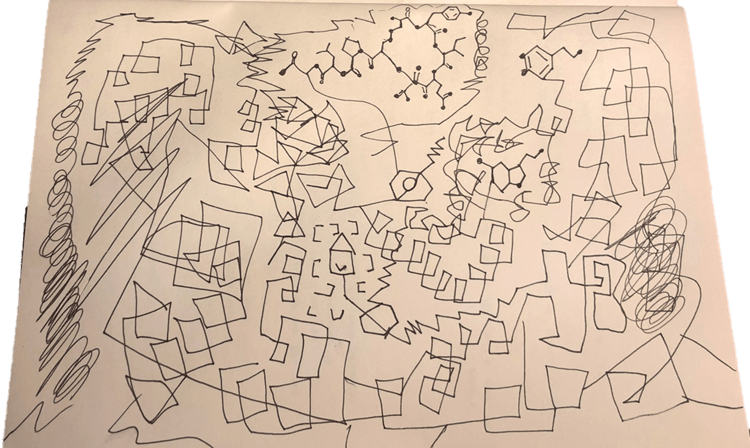
Figure 1. My attempt at representing a headless, bodyless, and skinless salmon thinking.
I ask you what it says:
void myfunction (datatype argument) { // any statement(s)
}
Output function (scream) {
AAAAAAAAAAAAAAAAAAAAAAAARRRRRRRRRRRRGGGGGGGGGGGGGGGHHHHHHHHHHHHHHHHHHHHHHHHHHHHHHHHHHHHHHHHHHHHGHHHHGH – 01101000 01100101 01101100 01110000. }
Can it taste and smell as we do, or does it just fade into the innumerable lines of codes that compose its body?
- “I think we should discuss the possibility of increasing your medication dosage, ” the Doctor tells you.
- You nod and reply, “But will the drugs answer if salmon can swim without its skin?”.
Analysis of poem
I wrote the first iteration of a series of poetic musings, titled “Can a Prawn Swim Without Its Body”, on a hot summer thundery night in Munich at around 2 AM, with the following accompanying description:
Eines Tages konnte ich nicht schalfen, weil ich spürte die Sommergewitter mich egriffen. Deshalb dachte ich mir und fragte mich den berümpten Aphorismus von Nietzsche: „Wenn du lange in einen Abgrund blickst, blickt der Abgrund auch in dich hinein“ (§. 146)
On a similar night, albeit cold and rainy, I couldn’t sleep due to my diet of black coffee, Snus, and sleep deprivation. While my eyelids flickered and drifted between the planes of dreams, reality, and more, I began to compose another poem in my series of imagined mutated aquatic creatures. This poem was titled “Can a Salmon Swim without its Skin”, and in a similar fashion to how Man Ray used Lee Miller as a muse for his surrealist aesthetics, I found my muse in the nudity of AI. Through this, I transcribed my attempt at what André Breton calls “[p]sychic automatism in its pure state” (26).
The AI image above first struck me months ago while browsing Twitter, as I am certain it would for everyone, for its utterly absurd attempt at representing salmon swimming in water because, as we know, salmon do not swim as butchered fillets. Despite this immediate reaction to the absurd image generation, it slipped deeper and deeper into my unconscious until it gripped hold of me one night. The surreality of this image became as ephemeral as what Roy Batty describes as “tears in rain” (1:46:48-52). Therefore, there are, I believe, parallels between Batty’s nihilistic monologue and contemporary fears of the encroaching dangers of generative AI software on artistic and academic freedoms and expressions. However, the image above displays an almost comical pastiche of what Breton describes as the loss of “the imagination” (10) and how “children are weaned on the marvellous” (15). Through this, there is an almost naïve and marvellous rendering of a child’s imagination in the image. It evokes a comical rendition of the Freudian Unheimlich feeling; however, rather than the human reacting to the automaton, the automaton mechanically finds our world Unheimlich.
When I attempted to respond to the image using “psychic automatism” (Breton 26), my representations failed, as there was a chasm created between the human poet and its machinic muse. Consequently, when I ask the question, “Can it swim?” I am ascribing a living agency to a non-living object. You could argue that the salmon in the picture are not living outside the confines of the generated image. However, such a claim ignores how generative AI scrubs the internet to generate the desired output; therefore, these images were real at some point, but they have been stretched, pulped, and reconstructed for this image, akin to surrealist art forms like readymade objects or collages. Through this, the AI image embodies a new “kind of absolute reality, a surreality” (Breton 14). A “surreality” that I attempted to encode through my drawing of how the skinless salmon thinks, with innumerable crisscrossing lines and skeletal formulae. Therefore, the “surreality” of AI sits above our reality of neurons and flesh and instead roams along the plateaus of endless lines of computer codes.

 ether writes