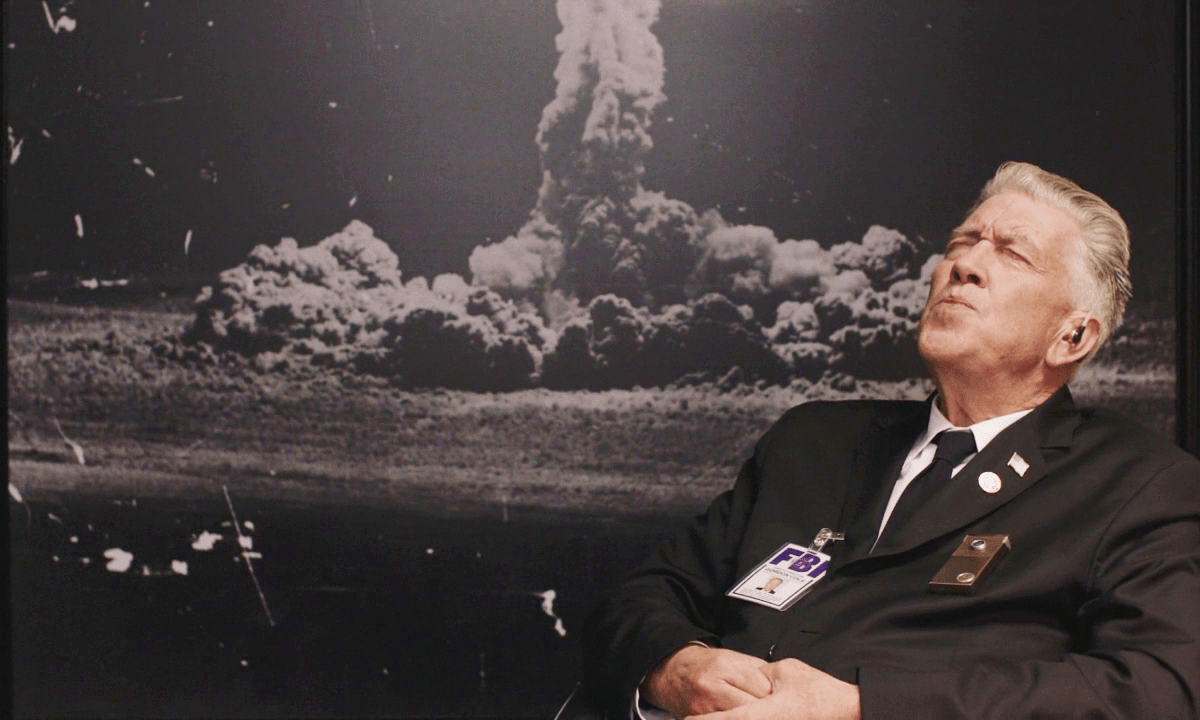
In feminist philosopher and theoretical physicist Karen Barad’s 2010 article “Quantum Entanglements and Hauntological Relations of Inheritance” [“Quantum Entanglements”], they invite the reader into a performative narrative of how electrons experience the world and how, in doing so, Barad’s arguments are not confined by spatial, temporal, or material constraints. Through this, Barad reinterprets Jacques Derrida’s notion of hauntology from his 1994 Specters of Marx and reinscribes Hamlet’s famous line, “The time is out of joint” (1.5.21) to explore their neologism “spacetimemattering” (244). Spacetimemattering denotes how space, time, and matter are not separate entities that interact and influence each other, but instead, they are entangled entities interwoven in a quantum field. Through this, spacetimemattering denotes a specific example of Barad’s framework of agential realism. Barad rejects the notion that agency is pre-established; instead, they argue that agency emerges and continuously reemerges through the dynamism of forces in “intra-action”. (Meeting the Universe Halfway 141). Therefore, in this essay, I would like to propel more agents into Barad’s notion of spacetimemattering: the intra-action of the many worlds of David Lynch’s Twin Peaks.
Although surrealism and quantum physics originated in Paris and Göttingen, respectively, they emerged contemporaneously and have subsequently irrevocably changed the world in distinct ways. Through this, both movements sought to move beyond the constraints and absences located in classical physics and “living under the reign of logic” (Breton 9). Consequently, Breton’s belief in the ideal of fusing “dreams and reality […] into a kind of absolute reality, a surreality” (13) exists on a similar stage to certain interpretations of quantum physics, namely of Niels Bohr, Werner Heisenberg, and Erwin Schrödinger. Through this, surrealism and quantum theory exist not as separate entities but interwoven agents in what this essay terms Quantum Surrealism. Therefore, a spacetimemattering of quantum theory and surrealism can be observed in the universe of David Lynch and Mark Frost’s Twin Peaks. This essay will specifically focus on the 2017 revival episode “The Return, Part 8” and interrogate how Lynch engages in a fictionalised expansion of Barad’s spacetimemattering with the philosophy and aesthetics of surrealism through his depiction of the Many-Worlds-Interpretation of quantum theory. The world of Twin Peaks diffracts the entanglement between space, time, and matter in observable reality and alternate dimensions.
Intra-action, Spacetimemattering, and Nuclear Imagery.
In this first section of the essay, I would like to expand on Barad’s theories of spacetimemattering and, more broadly, their theories of intra-action and the importance of maintaining what they term “ethico-onto-epistemology” when applying scientific knowledge production, like quantum physics, to non-scientific disciplines, like surrealism. Through this, I will explore the ethical imperative that is demanded by Barad when exploring nuclear imagery, the need to acknowledge the Native Americans who lived in the vicinity of the 1945 Trinity Test site, the victims of Nagasaki and Hiroshima, and the innumerable indigenous communities affected worldwide. Through this, the fission on a large scale of what is etymologically a “particle incapable of further division” (OED) signifies a rupture in space, time, and matter. A rupture that Lynch explores to elucidate his particular example of the intra-actions of Quantum Surrealism.
As a trained theoretical physicist, Barad is interested in the interconnectedness of materiality, discourse, and agency through which they propose a radical reconfiguration of overcoming historical philosophical dualisms; they term this method “agential realism”. An apparatus which reconfigures what Bohr terms phenomena, whereby “phenomena are the ontological inseparability of intra-acting agencies” (Meeting The Universe Halfway 206). Crucially, however, Barad maintains that “phenomena are not the mere result of laboratory exercises engineered by human subjects but differential patterns of matterings“. The term intra-action refers to how Barad seeks to replace the term “interaction”, whereby interaction refers to when two entities interact, they maintain a level of independence or agency from one another. Contrarily, intra-action denotes how entities materialise through their intra-action, and their agency emerges from within the dynamisms of forces entangled in the relationship, akin to how particles entangle in a quantum field. (141). One example of how intra-action functions is through nuclear explosions; not everybody will interact with the forces of the blast, but everybody will intra-act or entangle with the dynamisms of forces that emerge through the blast. This is one of the central concerns of their article “Quantum Entanglements and Hauntological Relations of Inheritance”.
Barad begins their article by critiquing Michael Frayn’s 1998 play Copenhagen, where Frayn stages a speculative 1941 conversation between German physicist and leader of the Nazi atomic weapons programme Werner Heisenberg and Danish physicist Niels Bohr. Barad takes issue with the play’s misinterpretation of the “Copenhagen interpretation” of quantum physics, the consequence of which appears to absolve both parties of guilt. Barad argues, “[s]cience and justice, matter and meaning are not separate elements that intersect now and again. They are inextricably fused together” (“Quantum Entanglements” 242). This is an example of the necessity of what they term “ethico-onto-epistemology” or “ontoepistemological”, as it marks how theories of being (ontology) and theories of knowledge (epistemology) should always be concerned with their ethical implications (Barad Meeting the Universe Halfway 185). Therefore, there must be a recognition of how the shaping of the “Atomic Age” was dependent on the necropolis created from atomic tests and bombs on Native American people, the Japanese survivors and victims of Hiroshima and Nagasaki, and the worldwide impact on numerous indigenous communities. The danger of Frayn’s play lies in assuming that if space, time, and matter are an entangled neologism, spacetimemattering reiterates the already prevalent revisionism of those who have suffered from nuclear bombs and test sites.
This is of particular importance because revisionism is repeated throughout the public consciousness, whereby quantum theory signifies an innocent scientific mumbo-jumbo deus ex machina that moves the plot forward, for example, in an episode of Doctor Who. However, there is also a sinister element to the misuse of quantum physics, whereby the danger lies in ignoring the ethical implications of how quantum physics “gave birth to the atomic age [and] is deeply entangled with the military-industrial complex” (Barad “Troubling Time/s And Ecologies of Nothingness” 60). This sinister ignoring of the ethico-onto-epistemology is also displayed in Christopher Nolan’s 2023 blockbuster biopic Oppenheimer, where Nolan occludes any mention of the 19 Native American pueblos, two Apache tribes, and chapters of the Navajo Nation living within a 50-mile radius of the Los Alamos research site (Atomic Heritage Foundation). Furthermore, there is no mention of how Hispanic homesteaders were given 48 hours to leave their homes and land at either gunpoint or compensated at a “significantly lower rate than white property owners” (Hay). An injustice that has never been formally acknowledged by the U.S. Government and only released to the public in 2014. The only mention of those living in the Jornada del Muerto desert is when the titular J. Robert Oppenheimer remarks that “the local Indians come up here for burial rites” (47:36). This is further accentuated by the long, sweeping, cinematic landscape shots that perpetuate the notion that the desert was uninhabited.
However, Nolan is not unique in this omission of the Native American presence; Lynch also depicts the Jornada del Muerto as a vast, empty wasteland. However, rather than panning over the barren landscape, Lynch shoots in black and white, perhaps as an allusion to the apocalyptic background of his earlier 1977 Eraserhead, and displays an almost static shot of the desert before a countdown is heard. The blinding whiteness of the mushroom cloud illuminates the shot.
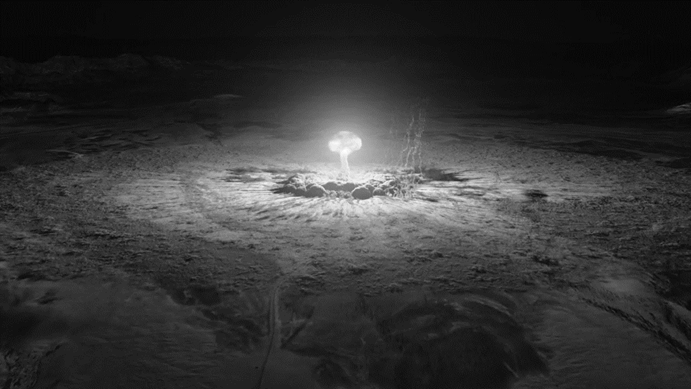
The camera slowly zooms into the explosion while simultaneously, the shockwave represents the erasure of the desert background and Native American presence from the frame. Lynch’s choice of soundtrack is interesting; as we, the viewer, enter into the explosion, the silence of the desert is replaced by Krystof Penderecki’s “Threnody to the Victims of Hiroshima”. Using Penderecki’s Threnody is interesting as it was dedicated to the Hibakusha, whereby Lynch acknowledges the oncoming nuclear holocaust for the Japanese but omits the Native American experience. Although absent, in this episode, the Native American experience is explored through the character of Deputy Chief Hawk and most clearly in “The Return” when Margaret “Log Lady” Lanterman tells Hawk how Dale Cooper’s disappearance has something to do with your heritage” (“The Return, Part 1”). However, as noted by Michael Carroll that Hawk is symbolic of “the noble savage … friend of the white man who yet preserves some of his Indian ways and is possessed of mystic knowledge (291), this criticism by Caroll is valid as it reiterates the need to maintain an ethico-onto-epistemology when producing media concerned with the mistreatment of marginalised groups.
Furthermore, returning Penderecki’s “Threnody to the Victims of Hiroshima” can be considered to be stylistically aligned with the avant-garde “sonoristic” period of the early 1960s, whereby the intra-action of the 52 string instruments signifies the “development [ment] [of] a new musical language” (Delisi 11). Through the chaotic timbre of Penderecki’s “Threnody” and the visual depiction of the transmutational violence of the mushroom cloud, Lynch’s “The Return, Part 8) does not only serve as what Mark Frost describes as an “origin story [for Twin Peaks, [showing]] where the pervasive sense of darkness and evil come from” (Reed), but also an origin story for the “Atomic Age” and Lynch’s obsession with the aesthetics of 1950s Americana. Through this, Lynch’s depiction of the Trinity Test signifies how time “is threaded through one another in a nonlinear enfolding of spacetimemattering” (Barad “Quantum Entanglements” 244).
The Atomic Age: 16th July 1945 [diffracted through] 24th February 1989.
In this section of the essay, I would like to interrogate the extent to which “The Return, Part 8” presents what Frost calls an “origin story, [showing] where this pervasive sense of darkness and evil come from” (Reed). Moreover, the extent to which the detonation of nuclear weapons signalled a new frontier in American consciousness, the Atomic Age. Through this, the notion of a definitive origin story becomes problematic by reading Twin Peaks as a fictionalised expansion or representation of Barad’s philosophy of agential realism and the spacetimemattering. Through this, one of the defining characteristics of Lynch’s filmography and surrealism, in general, is that there are no clear routes or paths. Instead, this episode and the rest of Twin Peaks embrace a kind of spacetimemattering narrative whereby dreams, temporality, and alternate dimensions are “threaded through one another in a nonlinear folding of spacetimemattering” (Barad “Quantum Entanglements” 244).
Rather than displaying a definitive “origin story” (Reed), “The Return, Part 8) engages in what this essay will term an origin story by way of nuclear fission chain reactions, enfolding past, present, and future through one another. Through this, just as Barad invites the reader to “engage in an imaginative journey akin to how electrons experience the world” (244), Lynch’s narrative invites the audience into a journey of how neutrons experience the world in nuclear reactions. Through this, Lynch’s construction of time is akin to how Argentinian writer Jorge Luis Borges describes time in his short story “The Garden of Forking Paths”, whereby “[t]his web of time — the strands of which approach one another, bifurcate, intersect or ignore each other through the centuries — embraces every possibility” (100). However, unlike Borges, Lynch’s depiction of the “web of time” is not a story of the endless branching of possibilities in the universe but rather depicts how time must be reconfigured through the ethico-onto-epistemological spacetimemattering of a nuclear explosion. Through this, there are two intra-acting chain reactions: the first is the detonation of the 16th July 1945 Trinity “Gadget” atomic bomb, and the second is the murder of Laura Palmer on 24th February 1989.
The Trinity Test signified a chain reaction that irrevocably changed how human and non-human agents interact with the world. The mass amounts of radioactive material dispersed into the atmosphere in the wake of nuclear bombs and testing signalled the end of the Holocene epoch and the start of a new, human-orientated epoch: the Anthropocene (Carrington). Additionally, the murder of Laura Palmer signifies a chain reaction that acts as a catalyst or opening of a wound for the audience and the protagonist, FBI Special Agent Dale Cooper, to enter into both the peculiarly charming town of Twin Peaks, Washington, and the surrealist worlds of Twin Peaks. However, contrary to conventional nuclear physics, whereby each neutron produced during fission releases a further neutron, whereby the number of fissions doubles with each generation, in Lynch’s Twin Peaks, the death of Laura Palmer is not necessarily a consequence or generation of fission, but rather the two chain reactions intra-act with one another through space, time and matter. The two are locked in a feedback loop that FBI Special Agent Dale Cooper attempts to shatter in “The Return, Part 18″. Therefore, the atomic blast sequence in “The Return, Part 8” situates an Einsteinian Gedankenexperiment (thought experiment) between two seemingly unrelated events and attempts to explore their intra-action. The intra-action of Laura’s death and the Trinity Test are both micro and macro representations of the Lynchean term “garmonbozia”, which is synonymous with “pain and sorrow” (Twin Peaks: Fire Walk With Me 2:07:33). However, this is not to state that Lynch’s nonsense word “garmonbozia” is at all suitable when describing the devastating impact nuclear weapons had on Native Americans in the Jornada del Muerto desert. Furthermore, there is an element of Derrida’s notion of hauntology and Barad’s reconfiguration of hauntology, whereby both the formation of spectral agents through the atomic blast and the murder of Laura Palmer signifies how the “past is not present. ‘Past’ and ‘future’ are iteratively reconfigured and enfolded through the world’s ongoing intra-activity of spacetimemattering” (Barad 260). Therefore, “The Return, Part 8” does not offer a definitive “origin story” (Reed) for the “garmonbozia” of the Trinity Test and Laura’s murder, and in treating this episode so problematises Lynch’s refusal to ascribe meaning to his art and his unique narrative structure.
The “Atomic Age” does not necessarily show a new beginning or mythology. However, instead, as Barad writes, all new beginnings are “always threaded through the anticipation of where it is going” (Barad “Quantum Entanglements 244), whereby Lynch invokes spacetimemattering as a narrative device. The temporality of the world of Twin Peaks is “threaded through one another in a nonlinear enfolding of spacetimemattering […] Time is out of joint. Dispersed. Diffracted” (244) through the ash of the mushroom clouds. The scenes of “The Return, Part 8” “never rest but are reconfigured within and are dispersed across and threaded through one another” (244-245). Lynch structures the episode across multiple non-linear temporalities, geographical locals, and planes of existence that intra-act with our reality. The episode jumps like electrons moving from different energy levels orbiting the nucleus; time is structured as decades apart, ranging from the present-day with Mr C and Ray to 16th July 1945 to 1956. However, time is also sped up with the time-lapse scenes of the Woodsmen entering the convenience store or the slow zooming towards the mushroom cloud; even time is frozen when the audience is invited into the castle of “The Fireman”. Lynch’s usage of spacetimemattering as a narrative device and his depiction of the mass fission of atoms in the atomic blast represent a complete fracture of reality. This crack allows the interdimensional beings and dimensions to haunt and intra-act with the world of Twin Peaks.
“Now I Am Become [BOB], the Destroyer of Worlds”.
In a 1965 interview, the lead scientist of the Manhattan Project, J. Robert Oppenheimer, reflected on how the now infamous line from the Hindu sacred text Bhagavad Gita ran through his mind as he witnessed the Trinity Test: “Now I Am Become Death, the Destroyer of Worlds” (Atomic Archive 0:43-0:50). The reason why I have substituted “Death” with “BOB” in this subheading is that it reiterates how the primary antagonist of the first two seasons, the interdimensional possessing entity Killer BOB, represents what Albert reflects after Leland confesses to the murder of his daughter, Laura, “Maybe that’s all Bob is. The evil that men do” (“Arbitrary Law” 45:04-45:10). Through this there emerges an ethico-onto-epistemology of the intra-action of the scientist Oppenheimer and the fictional being BOB. Both figures are symbolic of the “garmonbozia” or “pain and sorrow” (Twin Peaks: Fire Walk With Me 2:07:33) of nuclear explosions and the murder of Laura Palmer. Therefore, in this final section of the paper, I would like to explore how Lynch in “The Return, Part 8” and the rest of Twin Peaks depicts an expansion of Barad’s philosophy into the realm of the Many-Worlds-Interpretation of quantum physics.
The public consciousness’ understanding of the Many-Worlds-Interpretation (MWI) may stem from popular media genres like Sci-Fi, comic books, and, more recently, superhero multiverses. However, MWI originates in the work of American physicist Hugh Everett, who speculated that many worlds or dimensions exist in addition to what we observe. Everett’s theory posits that every time a quantum experiment with equally possible outcomes is attempted, all possible outcomes are achieved, each in a separate universe. (Vaidman). Everett takes his inspiration from Schrödinger’s attempt at preventing the collapse of the wavefunction equation, demonstrated by Schrödinger’s Gedankenexperiment of the alive/dead cat paradox. The infamous cat is used to dramatise the notion of measurement in quantum indeterminacy and superposition; there is an experiment where there is a box with a cat and a radioactive atom that is in the superposition of either decaying or not decaying if the atom decays the cat dies and vice versa. Schrödinger’s metaphor elucidates how, until it is observed, “there is no determinate fact of the matter about its condition” (Barad “Quantum Entanglements 251). Barad reinterprets Schrödinger’s cat to claim that it represents “an ontological/hauntological” state of superposition.
This state of being alive/dead, until observed, is shown in Twin Peaks through the characterisation of Laura Palmer; there are two worlds in which Laura is in a state of quantum superposition. Therefore, she is simultaneously alive/dead. Laura exists in two planes of existence: our perceivable reality and the reality of the inhabitants of the Black Lodge/Red Room. However, just as the Copenhagen interpretation states, when a wave-particle is observed, the wavefunction collapses, and the apparatus measuring the particle confines the wavefunction to whichever state of superposition the particle is. Therefore, Laura’s state of quantum superposition is determined by her murder, which acts as a Baradian mode of apparatus for measuring the “ontological/hauntological” (“Quantum Entanglements” 251) state of her superposition. This is displayed in “The Return, Part 2” during the conversation between the, now or perhaps always already, interdimensional being Laura. She replies to Dale Cooper’s statement that “Laura Palmer is dead” (18:45) with the ghostly entangled phrase “I am dead. Yet I live” (18:53-19:05). This contradiction is akin to Schrödinger’s cat; however, there is no collapse of the wavefunction. The human Laura Palmer is dead, and the interdimensional Laura was never “alive”; neither can exist on the same plane without transforming from a quantum superposition state to a fixed classical understanding of matter and ontology. However, when a particle is in a state of quantum superposition, it is not a dualistic relationship between two states of being; it works under the rubric of “One is too few, two is too many” (Barad “Quantum Entanglements 251). This problem of arithmetically ascribing binary states to quantum theory is evident through Lynch’s problematising of Laura’s state of alive/dead by propelling more agents onto the stage. There is additionally, the “good” Laura and the “bad” doppelgänger Laura (“Beyond Life and Death”), whereby the audience and Dale Cooper act as observers of this state of superposition, whereby it is unclear whether the Laura we see is the “good” one or the “bad one”. Through this, Lynch invokes a quantum Unheimlich rendering of the surrealist concept of the double, whereby unlike in quantum physics, where the observer determines the state of superposition, the different Lauras reveal themselves to the observer. Thereby signifying Quantum Surrealism. To understand how we, the audience, enter Quantum Surrealism, we must return to Lynch’s obsession with the atomic blast. For Lynch, the nuclear explosion functions as a quantum world splitter experiment whereby the uncontrolled fission reaction signified how beings from alternate dimensions can enter observable reality. Through this, there emerges an ethico-onto-epistemological framing of Oppenheimer whereby he represents the “evil that men do” (“Arbitrary Law” 45:04-45:10); therefore, when the Woodsman asks the question “Gotta Light” (“50:25) throughout the 1956 scenes of “The Return, Part 8”, it is a direct allusion to how Oppenheimer as a person and as an American myth reconfigures the ancient Greek myths of Prometheus and Pandora’s box. Through this, Lynch introduces The Experiment as a reconfiguration of all the evils of the worlds released by the opening of Pandora’s box. Lynch introduces The Experiment as a white, female-present abject creature that spews a stream of radioactive primordial vomit into a void.
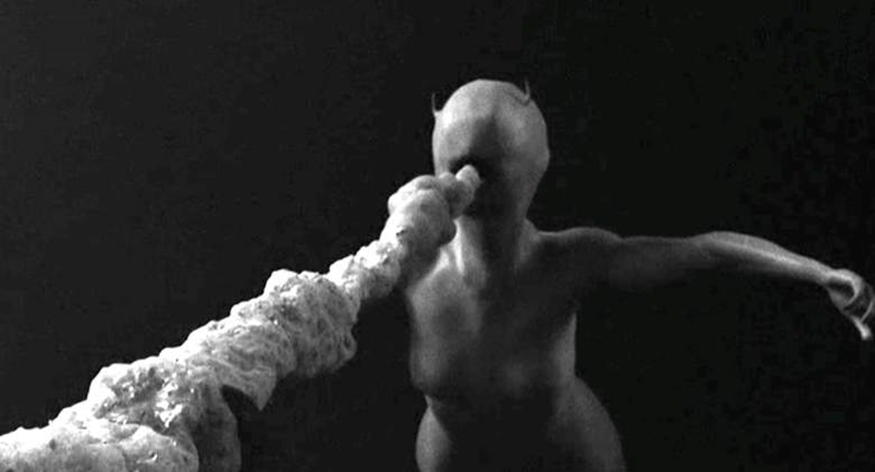
Located within the vomit are numerous greyscale orbs that signify the evil that has re-entered the world, whereby the violence of a nuclear explosion allows the overarching evil entity of Judy or Joudy to enter the world[1]. However, unlike Pandora’s box, whereby all the evil of the world is released along with hope, hope must be manufactured by the gaunt, giant-looking being, The Fireman. The Fireman levitates and projects a series of golden particles, through which Señorita Dido collects one of the orbs containing the face of Laura Palmer and projects it into the earth.

The golden orb represents hope, through Laura Palmer and eventually Dale Cooper to combat “the evil that men do” (“Arbitrary Law” 45:04:45:10). This is an example of how Lynch utilises spacetimemattering across multiple dimensions to delineate how “through the dark of futures past” (38:08), hope can be reimagined and “threaded through one another in a nonlinear enfolding of spacetimemattering” (Barad “Quantum Entanglements 244).
Conclusion: “Gotta Light, David Lynch?
I want to bring this paper to a close by reiterating that this is only one route along the Borgesian forking path that one can engage with when approaching the weird and surrealist world of David Lynch’s Twin Peaks. Through this, this paper has attempted to explore how Lynch’s cult TV series can be reconfigured through the philosophy of what Barad terms spacetimemattering, intra-action, ethico-onto-epistemology, and agential realism. Through this, I have demonstrated how Lynch’s Twin Peaks engages with Barad’s interpretation of quantum physics and other interpretations, such as the Many-Worlds-Interpretation. In doing so, a new and exciting hermeneutic arises to read Lynch’s world, which I have termed Quantum Surrealism. However, this essay has also attempted to stray away from relativising quantum theory and, in doing so, maintained what Barad terms “the political- ontoepistemological-ethical implications of temporal dis/junction by reading insights from Quantum Field Theory” (“Troubling Time/s And Ecologies of Nothingness” 56) concerning how Lynch’s Twin Peaks diffracts the intersections between interdimensional beings, multiple temporalities, and alternate dimensions.
Works Cited
“Atom, N., Etymology.” Oxford English Dictionary, Oxford UP, September 2023, https://doi.org/10.1093/OED/1187673930
Atomic Archive. J. Robert Oppenheimer “Now I am become death…” | Media Gallery, accessed 20th December 2023. <https://www.atomicarchive.com/media/videos/oppenheimer.html>.
Atomic Heritage Foundation. Native Americans and the Manhattan Project. 28th June 2016. <https://ahf.nuclearmuseum.org/ahf/history/native-americans-and-manhattan-project/>.
Barad, Karen. Meeting the Universe Halfway: Quantum Physics and the Entanglement of Matter and Meaning. Duke UP, 2007.
—. “Quantum Entanglements and Hauntological Relations of Inheritance: Dis/continuities, SpaceTime Enfoldings, and Justice-to-Come” Derrida Today, vol 3. no. 1, 2010, pp. 240-268.
—. “Troubling time/s and ecologies of nothingness: re-turning, re-membering, and facing the incalculable.” New Formations vol. 92, September 2018, pp. 56-86.
Breton, Andrè. “Manifesto of Surrealism.” Manifestos of Surrealism, translated by Richard Seaver and Helen R. Lane, U of Michigan P, 1969, pp. 1–48.
Borges, Jorge Luis. “The Garden of Forking Paths.” Ficciones, edited by Anthony Kerrigan, translated by Helen Temple and Ruthven Todd. Grove Press, 1962, pp. 89–101.
Carrington, Damian. The Anthropocene epoch: scientists declare dawn of human-influenced age, The Guardian, 29th August 2016.
Carroll, Michael. “Agent Cooper’s Errand in the Wilderness: Twin Peaks and American Mythology.” Literature/Film Quarterly, vol. 21, no. 4, 1993, pp. 287–295,
Delisi, Daniel J. Compositional Techniques And Use Of The Chorus In Five Selected Choral Works Of Krzysztof Penderecki (avant-garde, Twentieth-century Notation. U of Cincinnati, 1985. ProQuest, PhD dissertation . <https://uoelibrary.idm.oclc.org/login?url=https://www.proquest.com/dissertations-theses/compositional-techniques-use-chorus-five-selected/docview/303380044/se-2.>.
Hay, Andrew. ‘Oppenheimer’ and the story behind those who lost their land to the lab. 29th July 2023. <https://www.reuters.com/lifestyle/oppenheimer-story-behind-those-who-lost-their-land-lab-2023-07-28/>.
Oppenheimer, directed by Christopher Nolan, Universal Pictures, 2023.
Lynch, David, director. Twin Peaks: Fire Walk With Me, New Line Cinema, 1992
—.”Arbitrary Law”, Twin Peaks, Season 2, Episode 9, produced by David Lynch and Mark Frost, ABC, 1990
—. “The Return, Part 1”, Twin Peaks, Season 3, Episode 1, produced by David Lynch and Mark Frost, Showtime, 2017.
—. “The Return, Part 2”, Twin Peaks, Season 3, Episode 2, produced by David Lynch and Mark Frost, Showtime, 2017.
—. “The Return, Part 8”, Twin Peaks, Season 3, Episode 8, produced by David Lynch and Mark Frost, Showtime, 2017.
—. “The Return, Part 18”, Twin Peaks, Season 3, Episode 18, produced by David Lynch and Mark Frost, Showtime, 2017.
Reed, Ryan. The last word on “Twin Peaks” by David Lynch’s co-creator Mark Frost. 7th November 2017. <https://www.salon.com/2017/11/07/the-last-word-on-twin-peaks-by-david-lynchs-co-creator-mark-frost/>.
Vaidman, Lev. Many-Worlds Interpretation of Quantum Mechanics, edited by Edward N. Zalta. 5th August 2021, accessed, 3rd January 2024. <https://plato.stanford.edu/entries/qm-manyworlds/#:~:text=The%20Many%2DWorlds%20Interpretation%20(MWI,and%20thus%20from%20all%20physics.>.
[1] Judy is first referenced in Twin Peaks: Fire Walk With Me and again in “The Return, Part 18.”


